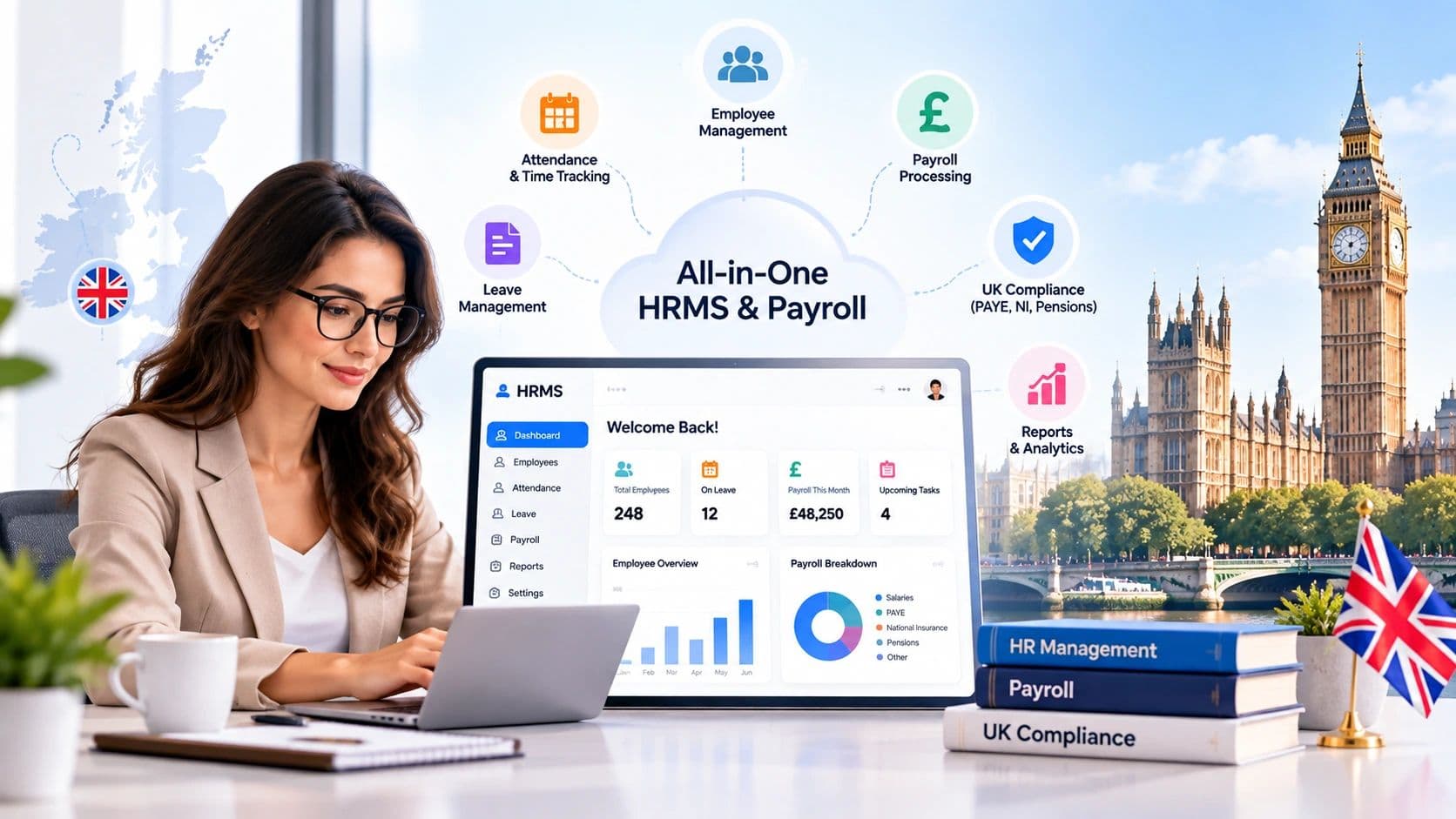
The Costly Juggling Act of Fragmented HR & Payroll
For many UK businesses, particularly growing SMEs, accountants managing client payrolls, and even established law firms, the administrative burden of HR and payroll can feel like a constant juggling act. Separate systems for leave requests, employee records, timesheets, and payroll processing often lead to fragmented data, duplicated efforts, and a higher risk of costly errors and non-compliance with HMRC regulations.
Consider the cumulative time spent manually transferring data between spreadsheets and disparate software, chasing approvals, and correcting mistakes. This isn't just inefficient; it diverts valuable resources away from core business activities and strategic growth initiatives. The real cost isn't just in wasted hours, but in missed opportunities and potential fines.
What is All-in-One HRMS and Payroll Software?
An all-in-one HRMS (Human Resource Management System) and payroll software integrates all essential HR functions, from recruitment and onboarding to performance management and offboarding, with precise payroll processing capabilities. Instead of using separate tools for each task, a single platform handles everything.
This means employee data, attendance, leave, expenses, benefits, and payroll calculations all reside within one cohesive system. The goal is to create a single source of truth for all employee-related information, automating workflows and ensuring consistency across the entire employee lifecycle.
Key Components You Should Expect:
- Employee Database: Centralised records for all employee information.
- Time & Attendance: Tracking hours worked, breaks, and overtime.
- Leave Management: Automated requests, approvals, and holiday accruals.
- Payroll Processing: Accurate calculation of salaries, taxes, pensions, and deductions.
- Benefits Administration: Managing employee benefits schemes.
- Performance Management: Tools for appraisals, goal setting, and feedback.
- Reporting & Analytics: Dashboards for HR and payroll insights.
- Employee Self-Service: Portals for employees to manage their own data, payslips, and leave requests.
Why UK Businesses Need This Integration
The UK's regulatory environment, from HMRC requirements to GDPR and pension auto-enrolment, demands meticulous record-keeping and precise calculations. An integrated system helps organisations navigate this complexity with greater ease and confidence.
For Growing SMEs: Scaling with Confidence
As SMEs expand, their HR and payroll needs become more complex. An all-in-one solution allows founders and operations leaders to automate routine tasks, minimise administrative overhead, and free up time to focus on strategic growth. It provides the infrastructure to support a growing team without proportionally increasing the administrative burden.
For Accountants: Enhanced Client Service & Efficiency
Accountants managing payroll for multiple clients often face the challenge of disparate data sources and manual reconciliations. An integrated HRMS and payroll system designed for the UK market streamlines these processes, ensuring accurate, timely payroll runs and robust compliance, ultimately enhancing the value they provide to their clients.

For Law Firms: Precision, Confidentiality & Compliance
Law firms operate with strict confidentiality requirements and often have complex leave policies and billing structures. An integrated system offers the precision needed for accurate payroll while ensuring employee data is securely managed and easily auditable, crucial for maintaining professional standards and regulatory compliance.
“An all-in-one HRMS and payroll system isn't just about software; it's about transforming how UK organisations manage their people, ensuring efficiency, accuracy, and unwavering compliance.”
The Tangible Benefits You'll Realise
1. Enhanced Efficiency & Productivity
Automating routine tasks like payslip generation, leave approvals, and new hire onboarding dramatically reduces manual effort. This frees up HR and finance teams to focus on more strategic initiatives, improving overall organisational productivity.
2. Guaranteed UK Compliance
The best all-in-one solutions are regularly updated to reflect the latest HMRC regulations, pension changes, and employment law. This minimises the risk of non-compliance, costly fines, and reputational damage, providing peace of mind to business leaders.
3. Improved Data Accuracy & Reporting
With a single source of truth, data integrity is vastly improved. Real-time reporting and analytics provide deep insights into workforce trends, payroll costs, and HR metrics, empowering better decision-making for founders and operations leaders.
4. Better Employee Experience
Employee self-service portals empower staff to access payslips, request leave, and update personal details independently. This transparency and ease of access boost employee satisfaction and reduces queries to HR, fostering a more engaged workforce.
5. Cost Savings
Beyond reducing errors and administrative hours, an integrated system can lead to direct cost savings by optimising resource allocation, minimising reliance on external payroll services, and preventing costly compliance breaches.
Choosing the Right All-in-One Solution for Your UK Organisation
Selecting the ideal HRMS and payroll software requires careful consideration. Here are key factors to evaluate:
- UK Specificity: Does it fully comply with HMRC regulations, P45s, P60s, RTI, and pension auto-enrolment?
- Scalability: Can it grow with your business, accommodating more employees and complex requirements?
- Integration Capabilities: Does it integrate with your existing accounting software, CRM, or other essential business tools?
- User Experience: Is it intuitive for both administrators and employees?
- Support & Training: What level of customer support and training is offered, particularly for UK-specific queries?
- Security: How does the platform protect sensitive employee and payroll data?
When evaluating options, consider platforms that offer comprehensive functionality tailored for the UK, such as AdminTree. Its HRMS capabilities, combined with CRM and AI-powered OCR for document processing, demonstrate a commitment to providing a holistic business management ecosystem designed to maximise productivity and minimise administrative burden for UK accountants, law firms, and growing enterprises.
Making the Transition Smoothly
Implementing new software can seem daunting, but a structured approach ensures a smooth transition. Start with thorough planning, define clear objectives, and engage key stakeholders. Data migration needs careful attention, ensuring accuracy and integrity.
Prioritise comprehensive training for your team and consider a phased rollout, starting with core functionalities before expanding. A good software provider will offer robust onboarding support to guide you through each step.
The Future of Workforce Management is Integrated
The days of managing HR and payroll through disparate systems are quickly fading. For UK businesses aiming for sustained growth, operational excellence, and unwavering compliance, an all-in-one HRMS and payroll software is no longer a luxury but a strategic imperative. It empowers organisations to focus on what truly matters: their people and their purpose.
By embracing an integrated solution, you're not just investing in software; you're investing in efficiency, accuracy, and the future success of your organisation.
Frequently Asked Questions (FAQs)
1. What is all-in-one HRMS and payroll software?
All-in-one HRMS and payroll software combines essential HR functions, employee records, attendance tracking, leave management, and payroll processing into a single platform. It helps businesses streamline operations, reduce manual work, and improve data accuracy.
2. What are the benefits of using integrated HRMS and payroll software?
Integrated HRMS and payroll software reduces administrative tasks, minimises data duplication, improves payroll accuracy, simplifies employee management, and provides better workforce reporting. It also helps businesses manage their HR processes more efficiently.
3. Why do UK businesses need HRMS and payroll software?
UK businesses must manage payroll reporting, tax deductions, workplace pensions, employee records, and data protection requirements. HRMS and payroll software helps organise these processes and supports compliance with relevant UK regulations.
4. How can HRMS and payroll software help small and medium-sized businesses (SMEs)?
HRMS and payroll software helps SMEs automate routine tasks such as leave approvals, attendance tracking, employee onboarding, and payroll calculations. This reduces administrative workload and allows business owners to focus on growth and productivity.
5. Can accountants use HRMS and payroll software to manage multiple clients?
Yes, platforms with suitable multi-client management capabilities can help accountants organise employee information, streamline payroll workflows, and reduce manual reconciliations across different clients. Features and access permissions vary by software provider.
6. Is HRMS and payroll software suitable for law firms?
Yes, HRMS and payroll software can help law firms manage employee records, attendance, leave policies, and payroll processing. Role-based access controls and appropriate security measures are particularly important when handling confidential employee information.
7. How does integrated HRMS software improve payroll accuracy?
An integrated system uses centralised employee information to reduce repeated data entry and inconsistencies between HR and payroll records. Automated calculations and validation checks can further reduce errors, although payroll results should still be reviewed before processing.
8. Does HRMS and payroll software help with HMRC compliance?
UK-focused payroll software can support HMRC-related processes, including Real Time Information (RTI) submissions, PAYE calculations, and the preparation of relevant payroll documents. Businesses should verify that their chosen platform supports their specific reporting and compliance requirements.
9. What features should businesses look for in HRMS and payroll software?
Businesses should look for employee database management, time and attendance tracking, leave management, payroll processing, employee self-service, reporting and analytics, security controls, and integration capabilities. UK businesses should also check support for relevant HMRC and workplace pension requirements.
10. How does employee self-service improve the employee experience?
Employee self-service allows staff to access payslips, request leave, and update permitted personal information without contacting HR for every routine task. This improves convenience, transparency, and the overall employee experience.
11. Is employee data secure in an integrated HRMS and payroll system?
A well-designed HRMS should include security measures such as role-based access controls, encryption, secure authentication, and audit logs. Businesses should also assess the provider's data protection practices to ensure they meet applicable UK GDPR requirements.
12. How should a business transition to a new HRMS and payroll system?
Businesses should begin by identifying their requirements, reviewing existing employee data, and planning data migration. They should then test payroll calculations, train employees and administrators, and consider a phased rollout to minimise disruption.
13. Can HRMS software integrate with accounting and CRM systems?
Many HRMS platforms support integrations with accounting software, CRM systems, and other business tools through built-in connectors or APIs. Businesses should confirm that the integrations they need are supported by their chosen platform.
14. How can AdminTree help businesses manage HR and business operations?
AdminTree offers HRMS and CRM capabilities designed to help businesses organise employee information and streamline business workflows. Its AI-powered OCR capabilities can also support document processing, helping reduce manual data entry. Businesses should review the available features to determine which best fit their operational needs.
15. Is all-in-one HRMS and payroll software worth the investment?
For businesses managing HR and payroll across separate tools, an integrated platform can reduce administrative effort, improve data consistency, and provide better operational visibility. The value depends on the organisation's size, requirements, software costs, and the time saved through automation.